Special guest Sarah Sahim joins us to discuss Richard E. Grant’s autobiographical film Wah Wah, about the dissolution of his parents marriage and his father’s alcoholism, agains the backdrop of the end of British colonial rule in Swaziland. What does this have to do with King Arthur? Well, as a goodbye gift to the visiting Princess Margaret, the British colonial community puts on a production of Camelot with a black Lancelot. A frustrating and frequently incurious film all around that squanders any opportunity to really grapple with the meaning of the end of an empire.
Starring Gabriel Byrne, Nicholas Hoult, Emily Watson, and Miranda Richardson. Written and directed by Richard E. Grant.
To hear the entire episode, join the Mary Versus the Movies patreon for $3/month to hear this and the entire series Hollywood Avalon: https://www.patreon.com/maryvsmovies.
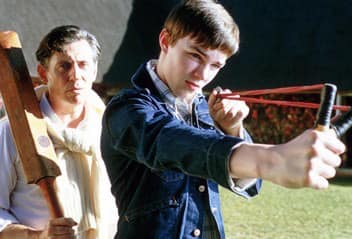
From the newsletter: On the surface, it falls outside our usual scope for the show—most of the film has nothing to do with the production of Camelot. But there is a coherent strand here, one briefly acknowledged by the film but never followed up on. Why perform Camelot? Set some time in the early 1970s, it’s not that surprising, it was a very popular musical, but here they’re performing it for Princess Margaret as part of the celebration of her visit to an African country that has recently broken away from the British Empire and become independent, where the white population is mostly looking at emigrating away from Africa and back to Britain. Performing a musical about the death of King Arthur, the ruin of his kingdom baked into its utopian vision, and furthermore performing it not only for a member of the royal family, but during the dissolution of the empire, is ripe with irony—and yet, that’s never really commented on except in the most facile way. It’s frustrating—there are all sorts of interesting parallels to be drawn between Grant’s story and Camelot (his mother’s unfaithfulness paralleling Guenevere’s; his father’s downfall that of Arthur’s; the end of Camelot and the end of the Empire), but it’s never dealt with at all.
We’re grateful to Sarah for bringing this movie to our attention—sometimes a movie that’s frustrating is actually just as enlightening as something competent. The cracks expose ideas, and we grapple with them and nail down exactly how a story can work and when it doesn’t.
 Mary vs the Movies